
The Best Rally Cars: A Technical Analysis

The best rally cars are true examples of automotive engineering, designed to withstand extreme conditions and offer high-performance performance.
Adverts
Whether on muddy terrain, gravel trails or icy tracks, these vehicles stand out for their combination of power, endurance and technology.
In this article, we will carry out a detailed analysis of the most relevant models, highlighting their technical characteristics, competitive advantages and history in the world of rally.
The Importance of Engineering in Rallying
Rallying is one of the most challenging forms of motorsport, requiring cars to be adapted to overcome extreme conditions.
It is no wonder that manufacturers invest in technological innovations to ensure that their vehicles are competitive.
advertising
Aspects such as adjustable suspension, 4×4 traction and turbocharged engines are essential for the models to stand out.
Furthermore, it is essential to consider ergonomics for pilots, as comfort can be decisive in long-duration competitions.
According to the International Automobile Federation (FIA), vehicles must meet strict safety and performance standards.
This includes structural reinforcements such as roll cages and high-efficiency braking systems.
However, beyond safety issues, engine configuration plays a crucial role.
Compact, turbocharged engines provide a perfect combination of power and lightness, ensuring better performance on adverse terrain.
The engineering of these vehicles also prioritizes durability, essential to withstand tests that can last several days.
Another essential point is aerodynamic development.
In rally, every corner, jump or straight demands maximum grip and control.
Innovations in this sector help to reduce drag, increase stability and improve fuel consumption, factors that can decide a victory.
+ The Power of Computer Vision: Applications and Trends
Iconic Rally Models
Subaru Impreza WRX STI
The Subaru Impreza WRX STI is one of the most celebrated models in rallying.
Equipped with a 2.5-liter turbo Boxer engine and symmetrical all-wheel drive, the vehicle offers impressive stability and control.
In addition, its reinforced suspension allows it to tackle rough terrain with ease.
- Power: 310 horses
- Torque: 393 Nm
- Suspension: Four-wheel independent
- Emphasis: Historic winner in the World Rally Championship (WRC)
The mechanical reliability of the Subaru Impreza WRX STI is one of its high points.
Its robust design and the quality of the materials used in its construction ensure that the model can withstand intense competitions.
Furthermore, the Boxer engine provides a lower center of gravity, increasing stability when cornering.
Another difference in this model is the Symmetrical All-Wheel Drive technology.
This system distributes torque evenly between the wheels, maximizing traction and car control on slippery surfaces, such as mud and snow, which are common in rally races.
Mitsubishi Lancer Evolution
Another classic that marked an era is the Mitsubishi Lancer Evolution.
Known for its cornering precision and explosive acceleration, the Evo has become synonymous with rally performance.
Its Super All-Wheel Control (S-AWC) traction system is a differential that guarantees grip on any terrain.
| Specification | Detail |
|---|---|
| Power | 303 horses |
| Weight | 1,515 kg |
| Maximum Speed | 250 km/h |
O Mitsubishi Lancer Evolution is widely recognized for its ability to adapt to different terrains.
Therefore, the S-AWC system integrates several subsystems, such as active steering and braking control, to offer greater precision and safety.
This integration makes the Evo a reliable choice for both amateur and professional pilots.
Furthermore, the aerodynamic design of the Lancer Evolution is not only visual, but also functional.
Every line and curve of the bodywork was designed to reduce drag and increase airflow, contributing to performance at high speeds.
Revolutionary Technologies
The best rally cars incorporate technologies that maximize efficiency and safety.
Some of the most relevant include:
- Intelligent Traction Control: Ensures stability on slippery surfaces.
- Brembo Brakes: Widely used for their accuracy and resistance to overheating.
- Adjustable Aerodynamics: Improves grip and reduces air resistance.
These advances not only increase competitiveness, but also serve as a basis for the evolution of passenger cars.
A recent innovation is the incorporation of high-precision sensors into suspension systems.
These sensors monitor terrain conditions in real time, adjusting suspension height and stiffness to optimize performance.
This technology significantly increases vehicle stability, even in extreme conditions.
Furthermore, advances in composite materials have allowed the production of lighter and more resistant cars.
The use of carbon fiber and aluminum alloys in the bodies reduces the vehicle's total weight, improving the power-to-weight ratio and contributing to greater agility on the track.
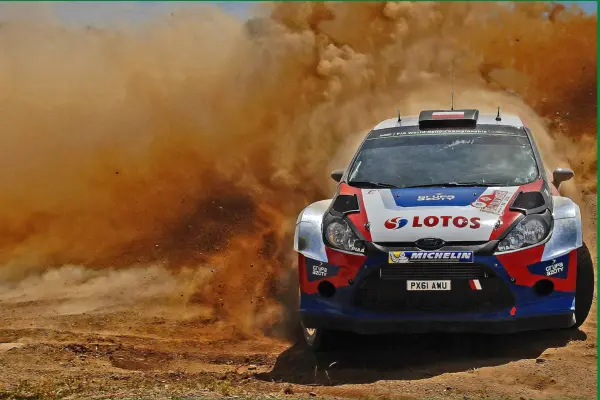
Comparison: Modern Rally Vehicles
| Model | Torque | Traction Type | Emphasis |
|---|---|---|---|
| Ford Fiesta WRC | 420 Nm | 4×4 | Robust suspension |
| Toyota GR Yaris | 370 Nm | AWD | Structural lightness |
| Hyundai i20 Coupe WRC | 400 Nm | 4WD | Electronic control |
Modern rally models are the result of extensive research and development processes.
The Ford Fiesta WRC, for example, has long-travel suspension and high-performance braking systems, which allow greater control over jumps and rough terrain.
The Toyota GR Yaris is known for its lightness and compactness.
Designed specifically for rallying, it incorporates design elements that maximize aerodynamic efficiency, ensuring greater stability even at high speeds.
Finally, the Hyundai i20 Coupe WRC stands out for its advanced electronic control system, which automatically adjusts parameters such as torque and suspension to optimize performance.
See too: The Power of Computer Vision: Applications and Trends
Sustainability and the Future of Rallying
With growing environmental concerns, manufacturers have started to invest in sustainable solutions for rally competitions.
The use of alternative fuels and hybrid engines is on the rise, making it possible to reduce the carbon footprint of racing.
One example is the Toyota GR Yaris Hybrid, which combines energy efficiency with performance.
According to the FIA, the goal is that by 2030, all competitions will be carbon neutral.
This transition is transforming the way rally cars are designed and manufactured.
The integration of sustainable technologies has also encouraged new approaches in design and engineering.
For example, the use of state-of-the-art batteries allows energy to be stored more efficiently, while kinetic recovery systems help improve performance without increasing fuel consumption.
This evolution is making rallying more accessible and environmentally responsible.
Conclusion
The best rally cars are not just high-performance machines, but also symbols of innovation and technological advancement.
Whether it’s engine power, suspension efficiency or the use of sustainable technologies, these vehicles continue to redefine the boundaries of motorsport.
When looking at the history and future of this sport, it is clear that the passion for rallying remains strong, fueling the desire for challenges and achievements.
However, constant technological innovation and a commitment to sustainability ensure that rallying remains relevant for decades to come.
Whether as entertainment or as a laboratory for new technologies, the sport continues to attract enthusiasts and inspire advances in the automotive industry.
